Sometimes, creating an opportunity starts with a simple question: What can I offer that people need?
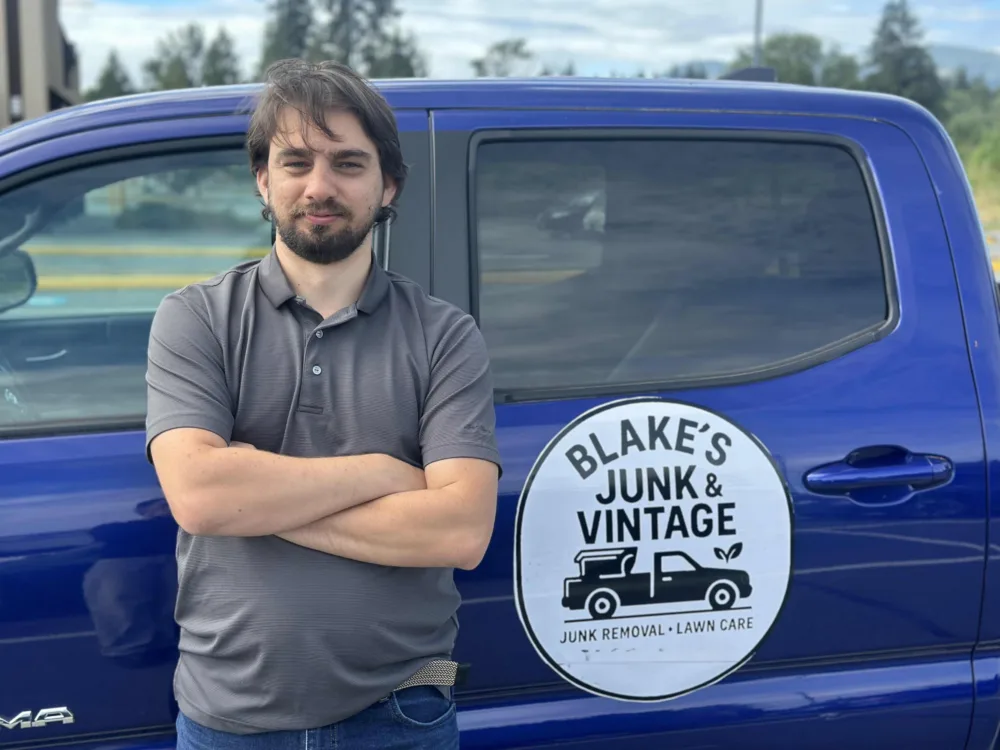
For Blake, the answer is growing a small business serving people throughout the Cowichan Valley.
Blake’s Junk & Vintage provides local hauling, junk removal and delivery services, helping people with everything from dump runs and yard waste to property clean-outs, moving assistance and picking up or delivering larger items purchased through Marketplace.
For Blake, the business is about more than hauling things from one place to another. It is a way to use his skills, interests and abilities to create an opportunity for himself while meeting a real need in his rural community.
“I wanted to find a way to use my skills and abilities to create my own opportunities,” Blake says. “I like working with equipment, being active, and getting a job done. Starting my own business gives me a way to turn those interests into something useful.”
A connection that sparked an idea
Blake’s story also demonstrates how networking and collaboration can create opportunities that may not have existed otherwise.
Through her work with Inclusion BC, Jillian connected with the BC Automotive Association (BCAA) Task Team. That conversation sparked an idea: Could the BCAA Task Marketplace help showcase the skills, services and businesses that people with disabilities have to offer?
The idea was worth exploring.
The Cowichan Valley is home to many talented people with disabilities who are pursuing employment in different ways, including self-employment and small business ownership. Clements Centre Society supports job seekers and people who are self-employed or building businesses in the community.
Together, Inclusion BC, BCAA and Clements Centre Society saw an opportunity to test how the Task Marketplace could support people like Blake.
Each organization brought something different to the partnership. BCAA provided the marketplace platform, Clements Centre Society brought its relationship with Blake and knowledge of the local employment community, and Inclusion BC helped connect the partners and explore how the opportunity could be used more broadly.
The first step was supporting Blake to set up Blake’s Junk & Vintage Collection on the BCAA Task Marketplace.
What began as a conversation between people in different organizations became a practical opportunity for a local entrepreneur.
Creating your own opportunities
For people with disabilities, finding meaningful employment can sometimes mean navigating systems and expectations that were not designed with everyone in mind. Entrepreneurship can offer another pathway, one that allows people to build around their strengths, interests and goals.
For Blake, self-employment means independence and the ability to build something of his own.
“It means I can set goals for myself, take responsibility for my work, and see the results of my effort,” he says. “It’s also about having the opportunity to contribute to my community and earn money doing something I’m good at.”
But building a business does not mean doing everything alone.
The power of a connection
Through his connection with BCAA, Blake has been able to learn more about promoting his business, connecting with potential customers and building confidence in what is possible.
The BCAA Task Marketplace gives him a way to reach people looking for help with smaller jobs.
“Having that kind of support and a place to start makes building a business feel much more achievable,” Blake says.
Another important part of the connection has been learning more about insurance and what it means to operate a small business. Understanding that he can take on smaller jobs while having coverage for personal injury and property damage has provided reassurance for both Blake and potential customers.
These connections can make a significant difference. A business owner may have the skills and motivation to provide a service, but building a business often requires people who can open doors, answer questions, share knowledge and help create opportunities.
From “What job can I get?” to “What can I offer?”
One idea from his experience particularly stayed with Blake: he does not have to wait for someone else to give him a job. He can create his own opportunities.
“That changed how I think about work,” he says. “Instead of only asking, ‘What job can I get?’ I can ask, ‘What can I offer that people need?’”
That shift moves the conversation toward what a person can contribute and how opportunities can be created.
It also highlights the importance of relationships and collaboration in inclusive employment. Sometimes a person needs information. Sometimes they need a business willing to give them a chance. Sometimes they simply need someone to ask, “Have you thought about trying this?”
And sometimes, one conversation between organizations can spark an idea that grows into something bigger.
“Don’t count yourself out.”
Blake hopes his experience will encourage other people with disabilities who are thinking about starting a business.
“Just try. You can have help. Don’t count yourself out, you’ll never know if you don’t take the risk.”
His advice is practical: think about what you are good at, what you enjoy doing and what people might be willing to pay you to do. Start small. Ask for help. Build from there.
“Having a disability doesn’t mean you can’t be a business owner,” Blake says. “You might just need to find the right supports and the right way of doing things.”
Building something for the future
Blake’s vision for Blake’s Junk & Vintage Collection continues to grow.
He wants to build his customer base throughout the Cowichan Valley, develop partnerships with businesses that need hauling services and eventually hire a reliable employee.
He also hopes to one day open a shop where he can reclaim pieces he picks up through his work, give them a second life through restoration, and resell them.
For Blake, entrepreneurship is not simply about creating a business. It is about recognizing his strengths, responding to a community need and building a future on his own terms.
To learn more about how we may be able to support connections in your community, contact employment@inclusionbc.org.
This article was featured in our monthly newsletter, Inclusion in Action.
Share this with your network: